I’m not an author. Sure, I might pop in here to write a blog post every once in a while, and in my professional life, I know how to put together a tight Product Requirements Doc. From time to time, I have even been known to employ the 6-page narrative as part of my product management process. But these occasional dalliances into the art of writing certainly don’t qualify me as an author any more than a trip to Top Golf and a couple rounds of mini golf make me a golfer.
And yet somehow, over the last couple of months, I wrote a novel.
Is the novel any good? No idea. Will anyone ever pay to read it? Doubtful. But whether it finds commercial success or not, or whether it is even any good, is not my primary concern. Instead, I’m just proud to say that I was able to write a full-fledged, 300+ page, coherent piece of literary fiction.
So how did I do it? Putting aside the couple of videos from Youtube and Masterclass, I have no formal training in writing novels, which left me slightly paralyzed when I sat down to embark on this journey. I had no idea where to start.
So instead of approaching it like an author, I approached it like a product manager, an area I’m much more comfortable with.
As a product manager, I have many responsibilities. PMs are required to manage project timelines, talk to customers, and craft user experiences. They have to prioritize competing priorities and coordinate disparate stakeholders. They have to do whatever is necessary to create the most compelling, impactful, and marketable solutions possible. But above all else, they have to be storytellers.
Writing a novel was going to be slightly different from crafting stories about new software features – I would have to expand the format slightly from my classic PRD and 6-page narrative templates – but I found that the underlying process could remain surprisingly consistent.
Start with the Big Idea
When we’re building software, every new feature or optimization should always connect back to the company’s Big Idea. It could be a specific company objective or metric, or maybe it’s a loftier experiment testing a new way to approach the problem at the core of the company mission. But whatever the product might be, fundamentally, it needs to solve a meaningful customer problem that aligns with the larger company strategy.
A novel works the same way. Throughout the story’s development, every scene, every piece of dialogue, every additional word or punctuation mark, all need to contribute to the book’s Big Idea. What’s the book trying to say? Who is it speaking to? Why does it matter?
Once I was able to answer these questions, I knew I had my North Star that could guide everything that would follow.
Competitive Analysis
With my Big Idea in place, I had to figure out how I wanted to structure the novel. Just like we would do on a development team, I set out to establish best practices and learn from my competitors.
But first I had to identify the right competitors to analyze, so I asked myself a simple question: what are the types of novels I enjoy the most?
To answer this question, in true PM fashion, I created a Book Trends spreadsheet, listing out my 20 favorite books and their respective authoring styles.

My “Book Trends Spreadsheet” with spoiler alerts galore.
Don’t look too closely at my notes here
From this overview, I could get a clear sense of how most of these best sellers were structured. Almost immediately, I noticed some common themes. Many of my favorite novels featured jumps in timelines and third-person narrators. For the majority of my favorite tales, the authors always featured a core question presented early in the story, with multiple twists and new questions popping up throughout.
Using this data-centric approach, I created a plan to structure my own story. The larger puzzle was starting to come into focus, but now I needed to figure out how all the pieces fit together.
Roadmaps and Wireframes
With a Big Idea and rough structure in place, I shifted my attention back to the basics. The spreadsheets, formulas, and analyses were replaced with pure, unadulterated creativity. Which for me, comes out best in the form of an iPhone note, the novelist equivalent of wireframes on a sketchpad.
Sitting down at my favorite local coffee shop, I just started writing out the story in the same way I would start drawing out a user journey for a new product initiative. Who are the main characters/personas? Who are the secondary characters in their orbit? What are their primary challenges? What do their lives look like?

After I had the initial sketch down, I gave it some time to breathe, but every once in a while, a new idea would come to me. I could be in the middle of a workout, stepping into the shower, strolling through a walk – but whenever inspiration struck, I would add it to the note.
Finally, after a week or two of ideation, it came time to start putting it all together, to start moving from low fidelity wireframes to medium fidelity designs. And for me, that meant spinning up a new spreadsheet to start building out the roadmap.

In each row, I thought through not just the plot pieces, but how each scene propelled the narrative forward. Leaning on some advice from South Park creators Matt Stone and Trey Parker, I approached the connection between every scene asking the question, “Is this a but, a therefore, or an and then?” As the story developed, I was looking for buts and therefores as opposed to and thens, for actions that would keep readers on their toes and turning pages rather than just plodding through a story.
Just Start Building. Learn as You Go
Having this spreadsheet in place was my great unlocker. The idea of sitting down to write a novel can be quite overwhelming. For most, it’s so daunting that they never get past the Notes App stage. But sitting down to write a single chapter? Translating a simple spreadsheet row into a couple pages of barely intelligible prose? That felt achievable.
So that’s what I did. I started migrating my spreadsheet rows into a long form Google Doc, my medium fidelity designs into a high fidelity prototype.
Every day, my goal was to write five more pages. Some days, I would hit a flow state, the words would just pour from my fingers, and before I knew it, hours would have flown by and I would have 20 new pages. On other days, I could barely muster the energy to write a single new page. But when I started, I had set a longer term goal of 50 pages before the end of that first month, and when I knocked that out in the first two weeks, I knew I was on the right track.
And then, after a couple months, I reached the end of my spreadsheet. The story was complete.
Well, the prototype anyway.
MVP Approach
Having a complete prototype meant that I had a fully functional, start to finish story. But as a PM, my ultimate goal was to reach my MVP milestone, to create an initial minimally viable product, and I had not yet reached viability. Stepping back and looking at what I had created – roughly 120 Google Doc pages (about 200 novel pages) worth of content – I was quite proud of what I had accomplished. But this was the part of the journey where the work really started.
So I scrolled back to the beginning and started reading. Throughout this first revision cycle, there were moments when I couldn’t believe such beautiful words had emanated from my simple little brain. This was going to be a smash hit!
But then I would keep reading, and quickly remember that writing books is hard, and I had a lot of work to do before anyone else would want to read this jumbled mash of words, confusing timeline jumps, and hanging prepositions.
Eventually, though, I was able to work my way through it. Characters were developed, timelines were rearranged, and perspectives were shifted. ChatGPT was consulted. And somewhere between my second and tenth revision, I decided it was ready for launch. I had my minimally viable product.
Closed Beta Launch
As with any MVP, I started with a closed, trusted group of beta testers to validate my newest creation. I was still stuck in a constant pendulum, swinging between complete confidence that I would soon be a shoo-in for Oprah’s Book Club and the sad realization that I had just spent months working on garbage that no one would ever want to read.
But there was only one way to find out for sure, so I shot out a round of requests to ten friends asking if they had any interest in reading a novel I had just written. And much to my surprise, they were all eager to jump in!
After sharing the manuscript with this closed beta group, I sat back and anxiously awaited the feedback. Something about sharing 68,000 words feels significantly more vulnerable than deploying new code to thousands of users, but I just shut my eyes and went for it.
Within a couple of weeks, the feedback started pouring in. And once again, I was pleasantly surprised. People were actually enjoying it!

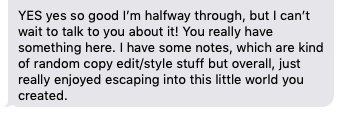
But more importantly, the beta group came back with some wonderful notes, feedback, and questions. If any members of that incredible group are reading this right now – THANK YOU!
Now What?
After receiving positive reviews and thoughtful notes from my closed beta group, I am now back in the lab, revising and tweaking the novel, iterating based on the feedback gathered during the trial period.
Once this latest revision cycle is over, I will look to release it to GA (general availability).
The publishing journey will undoubtedly have its own unique challenges and hurdles to overcome, and I have no idea how it will end up. Maybe I do find my way into Oprah’s good graces, or maybe this will just be a fun hobby and creative outlet to occupy my time during this little funemployment sabbatical period. But no matter what happens, it has been an incredible ride.
The process of writing a novel has completely changed the lens through which I view my surroundings. Building a fictional world has sharpened my ability to observe the actual world around me; as an aspiring author, I notice the nuances that previously went ignored. I appreciate the intricacies that make each character around me a unique individual. I enjoy the peaks and valleys of the story that is everyday life.
And more than anything else, it has reminded me that there is a novel to be found in everything we do. It could be a brand new, headline grabbing feature release, or a tiny shift in how you structure your meetings. Maybe it’s the tale behind your latest existential crisis, or maybe it’s just an account of the highlight of your morning.
But whatever it is, under the surface, between all the and thens, there’s a Big Idea somewhere, with a ton of buts and therefores ready to turn your story into a novel. We’re all storytellers at heart. Sometimes, it just takes an iPhone note and a couple spreadsheets to bring it out.
 Saft's Sanctuary
Leave a comment