I spent a year interviewing for jobs, and it sucked. Time after time, day after day, I would strap on my finest collared shirt and friendliest disposition as I tried to convince an endless stream of strangers that I was good enough, smart enough, and experienced enough to be a part of their company. With every interview and each passing month that went by without a job offer, the pressure would mount.

Will I ever find another job?
Am I doing something wrong?
Am I even good at this product management thing?
As it would turn out, I did find another job.
I wasn’t doing anything wrong.
And one month into my new role, I can confidently say that I do, in fact, know a thing or two about how to manage products.
But now that I have successfully reentered the workforce, I find myself back on the other side of the table. An interviewer crafting the job descriptions, asking the questions, and evaluating the interviewees. And I have stayed true to the promise I made to myself while I struggled through the job hunt grind, never forgetting the pervasive anxiety that plagued my inner monologue over the last year. I learned a lot of lessons during that time, not only about how to become a better interviewee and how to manage the stress of unemployment, but also about the right and wrong ways to conduct an interview.
Job Descriptions matter
The interview process starts with the job description. This is not only your opportunity to introduce the role, but also your opportunity to introduce the organization and set the tone for the entire experience.
Having read hundreds of job descriptions over the last year, I’ve highlighted some top Do’s and Don’ts when it comes to crafting an appropriate job description.
Don’t list hard requirements as “nice to haves.”
If the job requires a specific type of industry background or technical skill, don’t sugarcoat it as a “nice to have,” only to reject the candidate after three rounds of interviews because they are missing that particular qualification.
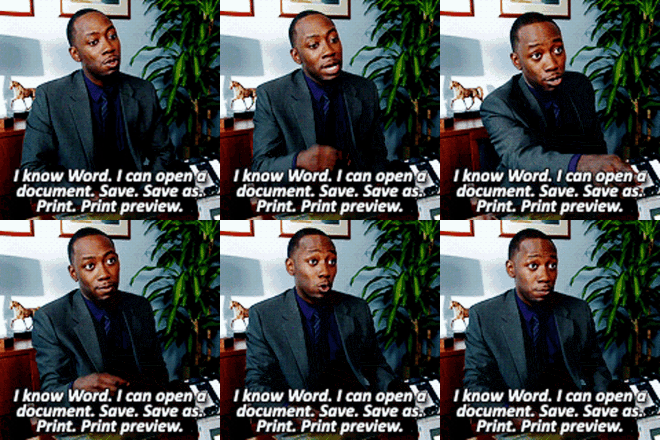
If the job requires candidates to work from the office, clearly state the in-person requirements. Don’t make candidates hunt for the answers to their questions.
Do be transparent about salary ranges
Similarly, a salary range can quickly make the difference between a worthwhile opportunity and one that doesn’t make sense for either side. Ensure that salary expectations are clear. This means including a range that is both truthful and helpful. If candidates have no chance of landing the upper band of the range, don’t imply that they can. And certainly don’t stretch your range across a spectrum that leaves a candidate with more questions than answers.

Show up on time and with energy
These salary ranges are crucial because no matter what your financial situation might be, not knowing where or when your next paycheck is coming is stressful.
And for many, “stressful” is a gross understatement. These job interviews can determine whether people are able to pay electric bills or afford health insurance. These interviews matter.
And yet, time and time again, I would show up for a call, nerves pumping, only to stare at myself in the Zoom room for 5-10 minutes while I waited for the other person to show up. Then, as I prepared to put everything I had into my pitch, the interviewer would kick off the meeting by complaining about how exhausted they were after a day full of back to back meetings.
Not exactly the positive reinforcement I was looking for to jumpstart the conversation.
As an interviewer, no matter how tired you might be or what baggage you might be bringing into the call, you have to remember that the person on the other side has been waiting all day, and maybe all week, for this moment. They are pouring everything they have into this opportunity, and you owe it to them to bring the same respect and energy.
Have a conversation
Once you get past holding in your yawns and complaints, use the energy you are able to muster to have a real conversation with the human being on the other side of the call. The goal of an interview is to understand not just whether the person has the necessary skills and background to do a particular job, but also to assess the interpersonal fit. When an interviewer is very clearly staring at their screen, running through a predetermined script of questions, barely listening to the responses and instead simply listening for specific keywords, it makes it very difficult to establish a flow or rhythm to the conversation.

Not only will this make it challenging to determine a candidate’s fit for the role and culture, but it will also paint a negative picture of the organization. Ideally, the candidate will be so impressive that they’ll have multiple competing offers, and as an interviewer, you don’t want to lose out on talent because you relied on a scripted assessment as opposed to simply being a human being.
Set proper communication expectations
Remember, that conversation doesn’t end when the Zoom is over.
If the candidate was respectful enough to send a note thanking you for your time, return the courtesy with a response recognizing the investment on their end. It takes two minutes, and it will go a long way toward making the candidate feel seen and appreciated.
Because on their side, that candidate will now spend the next couple of days and weeks refreshing their inbox, hoping for good news, their anxiety building with every passing day of radio silence.
So to avoid those unnecessary nerves, interviewers should always end conversations by setting an honest and transparent expectation of when the candidate should hear back regarding next steps. And if there is going to be any sort of delay, let the candidate know you need more time.
Delays happen. Rejections happen. Both are acceptable and expected parts of the process. But stringing a candidate along for weeks before providing an update on next steps, whether those next steps are positive or negative, is unacceptable.

Above all else, follow the Golden Rule
As I reflect on all of these learnings from my year of unemployment and carry them forward into this next phase of my career, the core lesson tracks back to what we all learned in elementary school.
Treat others as you would want to be treated.
It sounds simple, but it was shocking how often it felt like recruiters and hiring managers simply forget that there was a human being on the other side of the conversation. A human being that needs a paycheck and health insurance, but more than anything else, just wants to be treated with common courtesy and respect.
As long as we can all stick to that fundamental guiding principle, maybe the whole job hunt experience doesn’t have to suck so much, after all.
 Saft's Sanctuary
Leave a comment