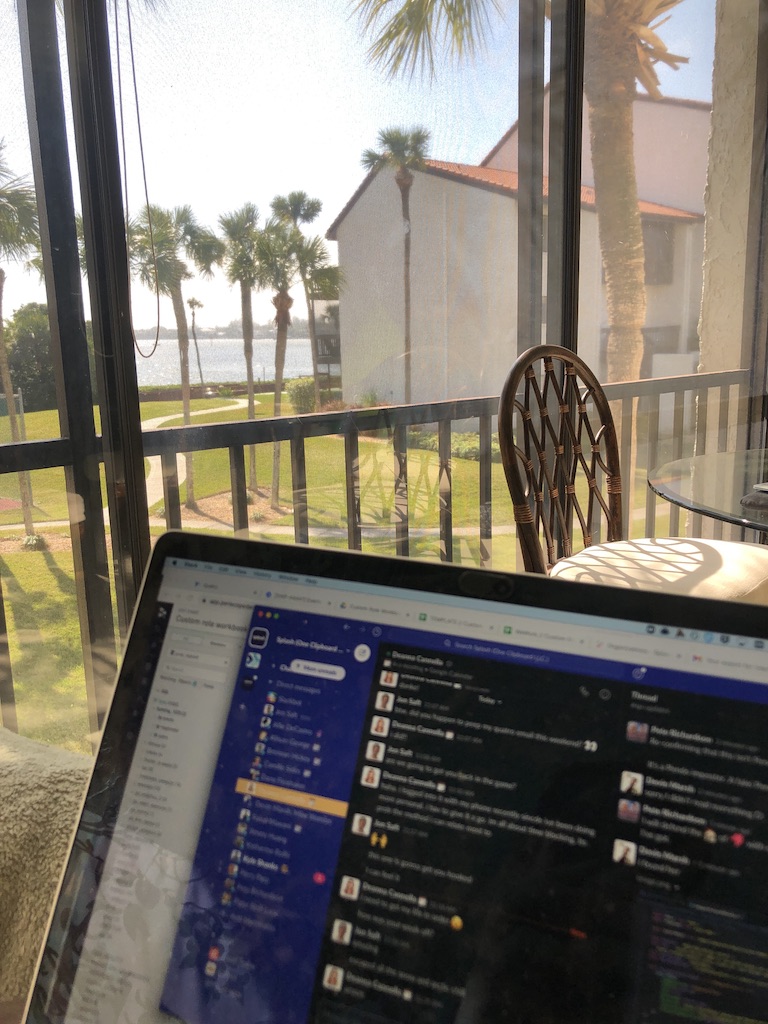
Since trading in my lease for a life of freedom, some might call me a “digital nomad,” others might refer to me as a “remote worker,” and my mom would be quick to remind me that I’m “technically homeless.” However you want to look at it, when I let my lease expire at the end of October and moved most of my stuff into storage, I set myself on a path of ambiguity and adventure that would have never been possible in the “before time.”
Before the pandemic reduced all of us into squares on a Zoom screen, we were tied to physical locations. The distance and complexity of the commute to our office was one of the primary factors determining where we wanted to live, so for many of us, that forced us into overpriced, undersized New York City apartments. But then 2020 hit and I, like many, fled the cramped confines of Manhattan in favor of the sprawling townhouses of Philadelphia. For a year, I enjoyed multiple outdoor spaces, a fireplace, and a parking spot in Philly for a fraction of the price I paid for my 5th floor walkup studio on the Upper West Side, but when it came time to renew my lease, I decided to see what else the world had to offer.
My company’s headquarters was conveniently located 10 minutes from my house, and I did have the option to go into the office in a “hybrid” capacity, but I very rarely opted in. When I did find the energy to get out of my sweatpants, I found myself walking into a relatively barren office. All the familiar elements of a lively startup office were there: fully stocked snack cabinets, comfy couches, cold brew on tap…you know the drill. But the energy just wasn’t the same. There were some benefits – I met a couple of the people I recognized from Zoom and enjoyed the banter during lunch, but generally speaking, I felt like I was working from home, from the office. Even meetings with others in the office were still facilitated through Zoom – despite the expensive video conferencing equipment on the wall, we each logged in through our own respective laptops to ensure a consistent experience for everyone on the call.
So why is it, two months into the fully remote life, do I find myself having a bit of FOMO related to my colleagues who are still able to go into the office? The nomad life has been amazing and is an opportunity that I might never get again, so I’m incredibly appreciative that I am able to do it and would recommend it to anyone else in a similar position. That being said, for anyone thinking about taking the plunge into 100% remote life, there is more to consider than taking meetings in your pajamas and waking up to palm trees. So before booking your storage unit and buying that one-way ticket to Costa Rica, here are a couple of the trade-offs to keep in mind:
- It’s hard to make friends on Zoom. With so many of us changing jobs over the last year, I’m sure I’m not the only person who has recently started a new position remotely and worried about building relationships. Six months into the new role, and I’m finding that those concerns proved to be valid. As we get older and our friends move to new cities and start families, your colleagues are typically the people you see and talk to more than anyone. But when those conversations are confined to the limits of a meeting agenda, it can be difficult to move relationships beyond the small talk that opens every call.
- Friends at work lead to better workers. According to research from Gallup, those who strongly agree they have a best friend at work are more than twice as likely to be engaged (63%) compared with those who say otherwise (29%), which totally makes sense. How many times have you been in a job interview where someone has asked, “What’s your favorite part of working here?” 9 times out of 10, the answer is going to be, “the people.” Without close friends, it can be harder to maintain the same levels of motivation.
- It’s harder to get promoted while working remotely. Promotions are harder to come by for a number of reasons. One reason, as noted previously, is that it’s easier to make friends at work when you’re going into the office, which will lead to more engaged employees and potentially lead to better work output. Additionally, even though remote workers are typically more productive, proximity bias tends to favor those who work in plain sight of their colleagues and managers. When you’re sitting within earshot of your manager, you’re more likely to be included in new, high value projects, and leadership is likely to remember and reward the effort they see you putting in as opposed to the work remote employees are putting in behind the scenes.
- It’s harder to say “no” in person. Perhaps most importantly, when you ask for a raise or a promotion in person, it’s harder for your manager or HR to say “no” when they see you in person every day. When you are in the office, not only do you develop relationships across the organization, you also develop a relationship with leadership. When it comes time for promotions, those relationships make it easier for leaders across the company to advocate on your behalf. Plus, if you have a manager or an HR team who continues to deny a well deserved request for a raise or additional perks, it becomes much harder to say “no” when you have to see each other at the water cooler as opposed to simply shutting your computer and waiting until the next review cycle to re-open the conversation.
I am very fortunate to work at a company that is extremely aware of these challenges and does everything they can to combat them. My first six months at my new company have been full of virtual happy hours, “donut” facilitated hangouts, and thoughtful check-ins from management and HR to ensure motivation, engagement, and career growth opportunities stay high. On the other side, I am also personally very aware of the challenges that remote work presents and personally make the extra effort to create relationships with my colleagues and managers. I also plan to take full advantage of the upcoming company off-site, an event I know will go a long way toward forging some of those lasting relationships and feelings of connectedness that can be so evasive in a remote-first world.
Nevertheless, when I have to miss the in-person holiday party or tune into a meeting with colleagues who are together, I am aware of the trade-off in front of me. No matter how many virtual happy hours we have or Zoom 1:1s my manager schedules, it will never be the same as the real thing. And that’s fine by me. Even if it’s not exactly the same, for me, the opportunity to travel the world and wake up to palm trees is worth it. But for everyone who sees the constant rotation of geotags on my Instagram and thinks it’s all roses, just remember, the “technically homeless” life has trade-offs like everything else.

 Saft's Sanctuary
Leave a reply to What Traveling Taught me about Product Management – Saft's Sanctuary Cancel reply