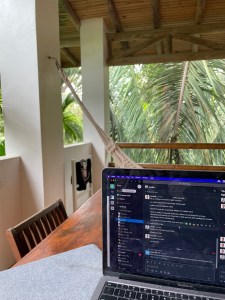
This week, I am coming to the end of my stint as a digital nomad. When I kicked off this journey, I knew it would be an incredible experience in so many ways – most notably, spending quality time with friends I hadn’t seen in years and seeing some of the most beautiful places in the world. At the same time, I was slightly concerned that it might conflict with my ability to do my job at the highest level. As I prepared for my first flight, I worried about my ability to find quiet work spaces, how reliable the WiFi would be at my Airbnb, and triple checked to confirm that I hadn’t confused the time zones for my early morning meeting the next day. Looking back on my time as a digital nomad, however, I now realize that I am undoubtedly a better product manager today than I was when I started.
Making the decision to go full nomad, career development was not at the top of my priority list. I was excited to replace the routine of a WFH life with the adventure of a nomadic one, but at no point while I was hiking volcanoes in Hawaii or learning to surf in Costa Rica did I expect to learn anything about building software. But to my surprise, despite having seemingly no relation to my day to day responsibilities, bouncing from city to city taught me a couple lessons somewhere along the way that I now bring to my job and my team every day.
Strong plans, loosely held
In the words of the wise philosopher, Mike Tyson, “everyone has a plan, right until they get punched in the mouth.”
There are two types of travelers: the first shows up at every stop fully prepared with agendas, timelines, and spreadsheets. The second shows up and just figures it out. I am very much the second type of traveler, with some caveats. I generally have a general outline of activities, sights, and restaurants, but if new information becomes available along the way, I am more than ready to adjust the plan and see where it takes me.
When it comes to being a product manager, I used to lean more toward the first type of traveler. I would show up to kick-off meetings with incredibly detailed product requirements, acceptance criteria, and design specs. After the kick-off meeting, I would fulfill my product owner responsibilities by checking in on progress every two weeks, answering any questions that came up along the way, and waiting for months while the team built my beautiful, perfect solution.
Today, the nomad in me reminds me that an original Product Requirements Document is just like a list of recommendations in a new city. Even though a certain restaurant might have 5 stars, once you get acclimated and start talking to locals, there might be a hole in the wall that serves the best meal in town. Similarly, once the team gets acclimated with the code base, maybe they’ll find a different route that solves your problem in a better way. Once the team has a chance to review the plan, maybe they’ll have a different perspective on how to roll the product out. And once users start interacting with that perfect solution, maybe inevitably you will realize that nothing is perfect, and the faster you can uncover the flaws, the better the end product will be.
So instead, I now constantly have my eyes and ears open for the hole in the wall restaurant, or the diamond in the rough product insight, and am always ready and willing to change course. Sticking to that original plan could cost you the best meal, or product, of your life.
Strong opinions, loosely held
Similar to plans, opinions are made to be changed. As new information becomes available and perspectives open up, holding onto the same, outdated opinion does not make you consistent. It makes you a fool.
My favorite part of traveling is meeting people from all over the world who approach the same situation in entirely different ways. I recently met a guy from Norway who told me he frequently walks around town in shorts and a t-shirt in below freezing temperatures. He explained to me that even though people look at him like he’s crazy, he could show me some breathing techniques that can change your physical body composition and allow you to withstand freezing cold temperatures like it’s nothing. Like everyone else, I looked at him like he was crazy, feeling strongly like I could never do something like that, but with a traveler’s mindset and an open mind, I agreed to give it a shot. Next thing I knew, I was sitting in a freezing cold ice bath for 25 minutes, using nothing but my breath to keep me warm.
The same has happened countless times in product development. As a product manager, I identify a problem and believe that I have the perfect solution. Skip the user testing, skip the workshops, let me just skip ahead and give you the right answer. Presented with freezing cold temperatures, I can tell you pretty easily that all we need are some heavy jackets and blankets. I’ve been around enough snowy northeast nights to know what I’m talking about here.
As a nomadic product manager, however, I now look for my friend from Norway (or more realistically, my product designer, internal stakeholders, customers, etc) to share their perspective and develop what was obviously the perfect solution into the actual solution, right until we test and figure out we still got it wrong and need to iterate again.
Budgets force creativity
More often than not, that “perfect solution” might actually be pretty good, but is probably overly complex and time intensive to be a viable option. The same is true when traveling, and just like in product development, the result is often better than the original idea.
Traveling with an unlimited budget has its obvious advantages. I’m sure staying in the most luxurious suites and flying private to every destination makes for a wonderful vacation, and I’ll be sure to update the blog as soon as I have the personal experience to confirm. But until then, what I can personally confirm is that traveling on a budget has actually brought some of my most memorable experiences. From trying street meat in Indonesia to putting my life in the hands of a teenage ferry boat captain in Colombia, exploring the world with some financial constraints always seems to leave you with a fun story.
Similarly, while I’m sure building software with unlimited time and resources must be fun in its own way, adding the pressure of a deadline and a small team often forces the team to have the hard conversations and decisions necessary to build truly innovative, simple products. Tasked with figuring out how to keep warm on a cold night in Norway, the easy, albeit expensive, answer would be to load up on heavy jackets and blankets. Without those kinds of resources, though, we are forced to get creative and use our breath. Maybe a little more difficult in the short-term, but in the long-term, now we can stay warm in any time or place, and we didn’t have to break the bank to buy any fancy jackets.
—–
Like all trips, my digital nomad journey had to come to an end eventually. The nomadic mindset, however, lives on. Despite unpacking my suitcase for longer than a couple weeks this time, the lessons and general attitude that come with the traveler’s lifestyle will continue to influence my approach to life in so many ways, including my role as a Product Manager. I will continue to stay flexible in my plans, my perspectives, and my budgets, always looking for the hole in the wall restaurant or unique breathing technique lying under the surface of every Requirements Doc. And moving forward, I’ll have the added benefit of knowing my time zone hasn’t changed and my WiFi won’t cut out. It almost feels unfair.

 Saft's Sanctuary
Leave a reply to Ellyn Saft Cancel reply